
After a car accident or personal injury in Georgia, the official police report is one of the most important pieces of documentation you’ll need. It provides a neutral summary of the incident, often including critical details like who was involved, what happened, and who may be at fault.
There are a few ways to request your accident report:
- Online via the Georgia Department of Transportation (GDOT) or other third-party services.
- In-person at the law enforcement agency that responded to the scene.
- By mail by submitting a written request along with a fee.
As part of our service, GMV Law Group obtains your police report at no cost to you and reviews it thoroughly while preparing your case.
To obtain a police report you generally need the following information:
- Date and Time of the Incident
- Location of the Incident
- Names of Involved Parties
- Your Relationship to the Incident
- Photo ID
- Payment
- Incident Number or Case Number – If you have it, this makes locating the report much easier.
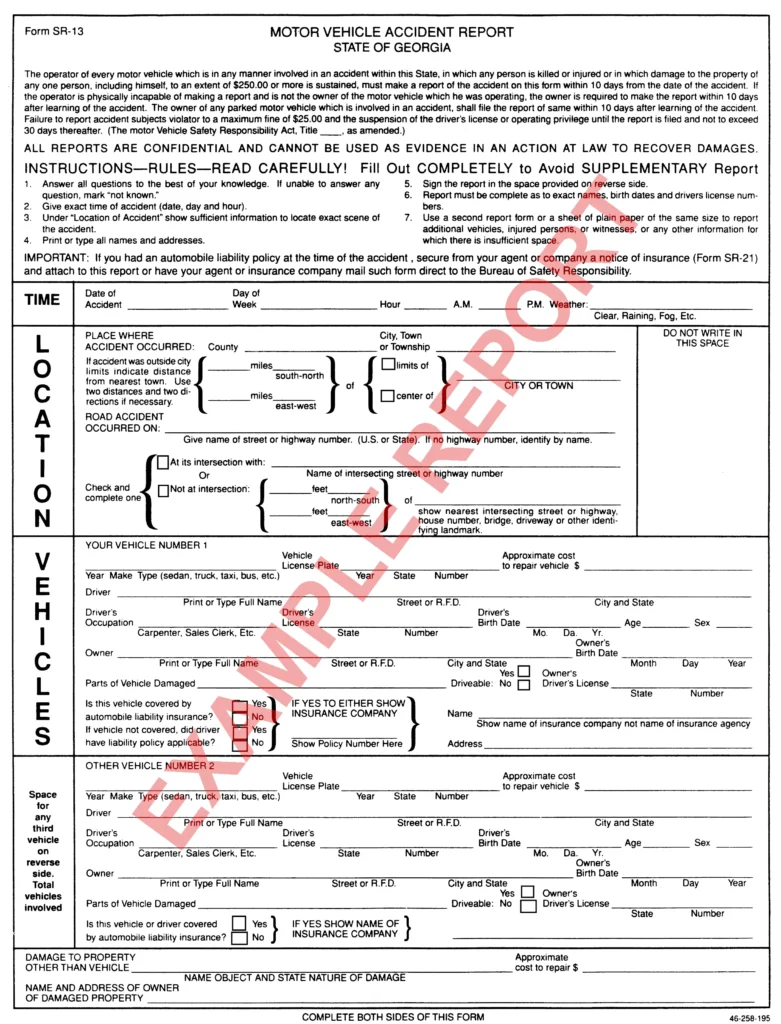
Why Your Police Report Matters
The police report isn’t just a formality. It’s often the first official record insurance adjusters, opposing counsel, and, if necessary, a jury will look at when deciding what happened and who’s responsible. A thorough, accurate report can:
- Establish a timeline of events while details are still fresh for the responding office
- Document road conditions, weather, and other contributing factors that might otherwise be forgotten
- Identify witnesses who can later confirm your version of events
- Note citations issued at the scene, which can carry real weight in an insurance claim
- Provide the other driver’s insurance information if you didn’t get it yourself
Because the report carries so much weight, it’s just as important to review it closely once you receive it. Officers make mistakes, especially with contact information, vehicle descriptions, or the sequence of events. If something in your report looks incorrect, it’s worth flagging early, before an insurance company relies on it to make a decision about your claim.
What Happens After Your Accident
Get medical attention first. Your health comes before paperwork, and prompt treatment also creates its own documentation trail.
Confirm a report was filed. Not every incident automatically generates one. If officers responded to the scene, ask for the reporting officer’s badge number or the incident number before they leave.
Give it time to process. Most Georgia agencies need anywhere from a few days to a couple of weeks to finalize and upload a report before it’s available for request.
Request the report using one of the methods above, or let our team request it for you at no cost.
Review it carefully for accuracy, then keep it with your other accident-related records, such as medical bills, photos, and insurance correspondence.
Checking Your Report for Accuracy
Once you have your report in hand, don’t just file it away. Police reports are written quickly, often at the scene or shortly after, and small errors are common. Reviewing it closely can catch mistakes before an insurance company relies on incorrect information to evaluate your claim. Parts of the report worth double-checking:
- Names and contact information — Misspelled names, wrong phone numbers, or incorrect addresses for drivers, passengers, or witnesses.
- Insurance information — Policy numbers and insurer names are sometimes transposed or entered incorrectly.
- Vehicle details — Make, model, color, and license plate numbers are occasionally mismatched between vehicles, especially in multi-car accidents.
- Diagram of the accident — The sketch of how vehicles collided should match what actually happened. Errors here can shift how fault is perceived.
- Narrative/description section — This is the officer’s written account of events. It should reflect what witnesses and drivers actually reported, not an assumption filled in after the fact.
- Fault determination or citations — If a citation was issued to the wrong party, or fault language doesn’t match the facts, this can significantly affect an insurance claim.
- Weather and road conditions — These are sometimes filled in generically rather than reflecting the actual conditions at the time.
If you find an error, it’s usually addressed by contacting the reporting officer or the agency’s records division directly to request a correction or supplemental report. This can take time, so the sooner an error is caught, the better.
Let Us Handle It for You
Requesting a report while you’re recovering from an accident is one more thing on an already long list. GMV Law Group will obtain and pay for your police report on your behalf, and review it as part of building your case.
Contact us today at 404-975-4878.
